Ritual as Urban Infrastructure
Understanding the Living System Behind Luang Prabang
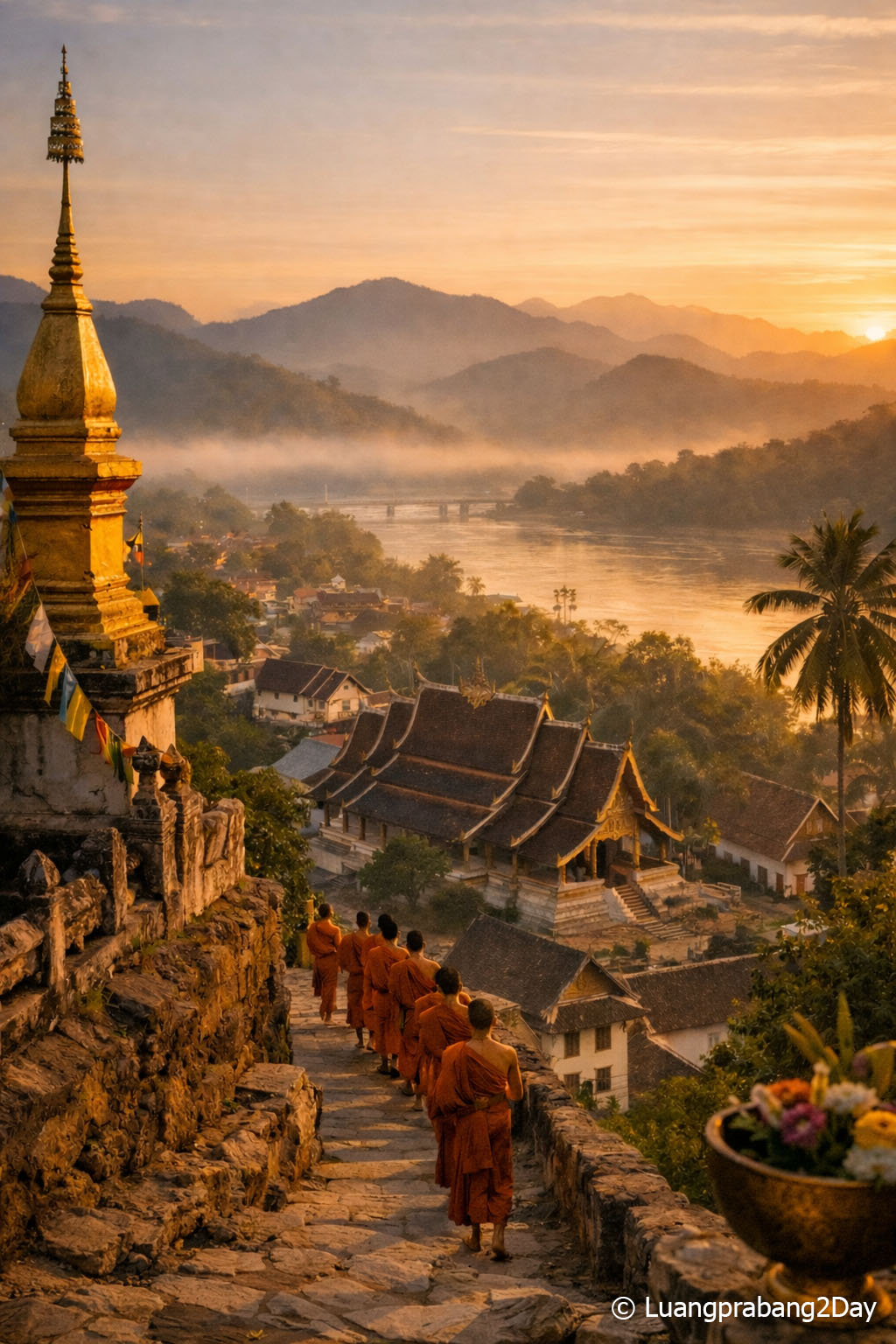
Luang Prabang is often described through what can be seen — temples rising softly at dawn, quiet streets framed by colonial and traditional architecture, and mountains meeting the river beneath a gentle, diffused light. These images circulate widely, shaping global imagination and establishing the city as a place of calm beauty and spiritual presence.
Yet what truly sustains Luang Prabang is not only what is visible.
It is rhythm.
More precisely, it is ritual time — a living cultural rhythm that quietly organizes how the city moves, behaves, and remembers itself across generations.
To understand Luang Prabang only through its buildings is to understand only half of the city. The visible landscape tells us where life occurs. Ritual explains how life continues to carry meaning.
This distinction is essential.
Luang Prabang is not preserved solely by conservation policies, tourism promotion, or architectural protection. While these efforts matter, they address primarily the physical dimension of heritage. The deeper continuity of the city emerges from shared practices — daily, seasonal, and spiritual — that guide relationships between people, space, and time.
In this sense, ritual is not ornamentation.
Ritual is infrastructure.
Infrastructure Beyond Concrete
In modern urban discourse, infrastructure typically refers to physical systems: roads enabling movement, electricity sustaining activity, water networks supporting survival, and communication systems connecting populations. These structures form the operational backbone of contemporary cities.
Heritage cities, however, depend on an additional layer of infrastructure — one that remains largely invisible yet equally vital.
In Luang Prabang, cultural infrastructure includes:
-
ritual calendars that organize communal time,
-
sacred boundaries understood without enforcement,
-
behavioral norms shaped through tradition,
-
intergenerational continuity sustained through repetition,
-
spiritual discipline encouraging restraint and mutual respect.
These systems rarely appear in development reports or planning diagrams. They cannot be measured through engineering metrics. Yet they regulate the social atmosphere of the city with remarkable precision.
They influence how loudly people speak, how spaces are approached, when celebrations occur, and when silence is collectively observed.
Without these cultural systems, Luang Prabang might still retain its architecture and scenic beauty.
But it would cease to function as a living cultural organism.
Physical infrastructure enables a city to operate. Cultural infrastructure enables it to remain itself.
Ritual Time as Cultural Governance
Ritual does not govern through authority or enforcement. It governs through meaning.
The recurring rhythm of ceremonies, offerings, festivals, and moments of collective reflection establishes shared expectations about time and behavior. People learn when to gather, when to celebrate, when to slow down, and when humility is required.
This guidance operates without coercion.
It may be understood as a form of cultural governance — not political administration, but a collective agreement sustained through shared understanding.
Ritual time establishes:
-
periods of renewal,
-
periods of restraint,
-
moments of collective responsibility,
-
spaces for reflection and reconciliation.
Through these rhythms, balance is maintained without confrontation. Social harmony emerges not from regulation but from participation.
In many modern cities, coordination depends on schedules imposed externally — working hours, traffic systems, institutional rules. In Luang Prabang, coordination also emerges internally through cultural timing.
This distinction explains why the city feels different. Movement follows meaning rather than urgency.
Cultural governance therefore operates quietly, shaping behavior before conflict arises.
It is governance through rhythm rather than regulation.
Sacred Boundaries and the Practice of Diplomacy
One of ritual’s most remarkable functions is its ability to create boundaries without conflict.
Contemporary societies often rely on visible mechanisms to enforce limits: signage, surveillance, legal restriction, or physical barriers. Luang Prabang demonstrates another possibility — boundaries maintained through shared awareness.
Ritual communicates, often without words:
-
what is sacred,
-
what requires permission,
-
what invites participation,
-
what asks for silence instead of attention.
These signals are learned gradually through observation and participation. Residents recognize them intuitively. Visitors encounter them as atmosphere — a sense that certain spaces call for quiet respect even without instruction.
This is where cultural diplomacy begins.
Cultural diplomacy, in this context, is not institutional negotiation but everyday sensitivity. It is the practice of recognizing cultural signals and responding with humility.
Diplomacy here does not restrict access. It cultivates relationship.
By understanding boundaries, individuals become participants rather than observers. Respect replaces intrusion, and coexistence becomes possible without tension.
Ritual thus functions as both guide and mediator, allowing diverse groups to share space harmoniously.
Ritual and Urban Memory
Cities remember differently.
Some preserve memory through monuments or archives. Others rely on documentation and historical narration. Luang Prabang preserves memory primarily through repetition.
Ritual acts as a form of living memory — history reenacted not for display but for continuity. Each ceremony reconnects present experience with inherited knowledge, allowing culture to remain active rather than nostalgic.
Through repetition, values are reinforced without instruction. Younger generations learn through participation rather than explanation. Cultural knowledge becomes embodied rather than abstract.
This process transforms ritual into an urban memory system.
The city remembers by doing.
When rituals continue, memory remains functional. When rituals weaken, memory risks becoming symbolic rather than lived.
Understanding ritual as infrastructure therefore reveals its role not only in organizing behavior but in sustaining identity across time.
Why This Matters Today
Tourism, photography, and creative production are not inherently threats to Luang Prabang. When approached thoughtfully, they can strengthen cultural exchange and global appreciation.
The challenge arises when ritual is misunderstood.
When living practices are interpreted primarily as visual assets — backgrounds for content, scheduled spectacles, or aesthetic experiences detached from meaning — representation begins to reshape behavior.
Ritual may gradually adjust to expectation rather than purpose.
This transformation is rarely intentional. It occurs subtly, as repetition changes perception.
The city does not suddenly lose identity. Instead, coherence slowly weakens.
A living heritage city survives not through visibility alone but through legitimacy — the shared recognition that certain practices sustain dignity and continuity.
Without legitimacy, preservation becomes performance.
Ritual as a Cultural Safety System
Modern infrastructure prevents physical breakdown.
Cultural infrastructure prevents cultural erosion.
If roads connect places and electricity enables function, ritual sustains atmosphere — preserving humility, patience, and social equilibrium.
It provides a cultural safety system, absorbing pressures introduced by change and maintaining continuity without rigidity.
For this reason, heritage protection cannot focus exclusively on buildings or zoning regulations.
Preservation ultimately concerns behavior.
And behavior is shaped most effectively not through enforcement but through shared understanding.
Ritual teaches that understanding gradually, through participation rather than instruction.
Toward a Diplomatic Practice of Documentation
Recognizing ritual as infrastructure invites new responsibilities for those who document or represent Luang Prabang.
Photography, filmmaking, and storytelling become most meaningful when they operate as cultural diplomacy — translating meaning rather than extracting imagery.
This requires:
-
contextual understanding,
-
respect for sacred boundaries,
-
dialogue with communities,
-
cultural accuracy,
-
ethical circulation of stories and images.
These principles do not limit creativity. They deepen it.
Creative work grounded in understanding builds trust — between storyteller and subject, visitor and resident, image and reality.
Documentation then becomes collaboration rather than consumption.
Such an approach protects not only the dignity of the city but also the credibility of creative professionals themselves.
Understanding Before Preservation
Luang Prabang remains a heritage city not because it is photographed, but because it is lived.
Its continuity depends on recognizing that ritual is not an accessory to culture. It is the system that sustains culture.
The future of Luang Prabang therefore depends not only on development strategies or promotional campaigns but on a deeper form of awareness:
the ability to recognize ritual as infrastructure,
and to approach it through diplomacy, respect, and shared responsibility.
Because sustainable preservation does not emerge from control.
It emerges from understanding.
And the most enduring protection of culture is not restriction.
It is diplomacy.
ABOUT THE AUTHOR
Hello We are OddThemes, Our name came from the fact that we are UNIQUE. We specialize in designing premium looking fully customizable highly responsive blogger templates. We at OddThemes do carry a philosophy that: Nothing Is Impossible