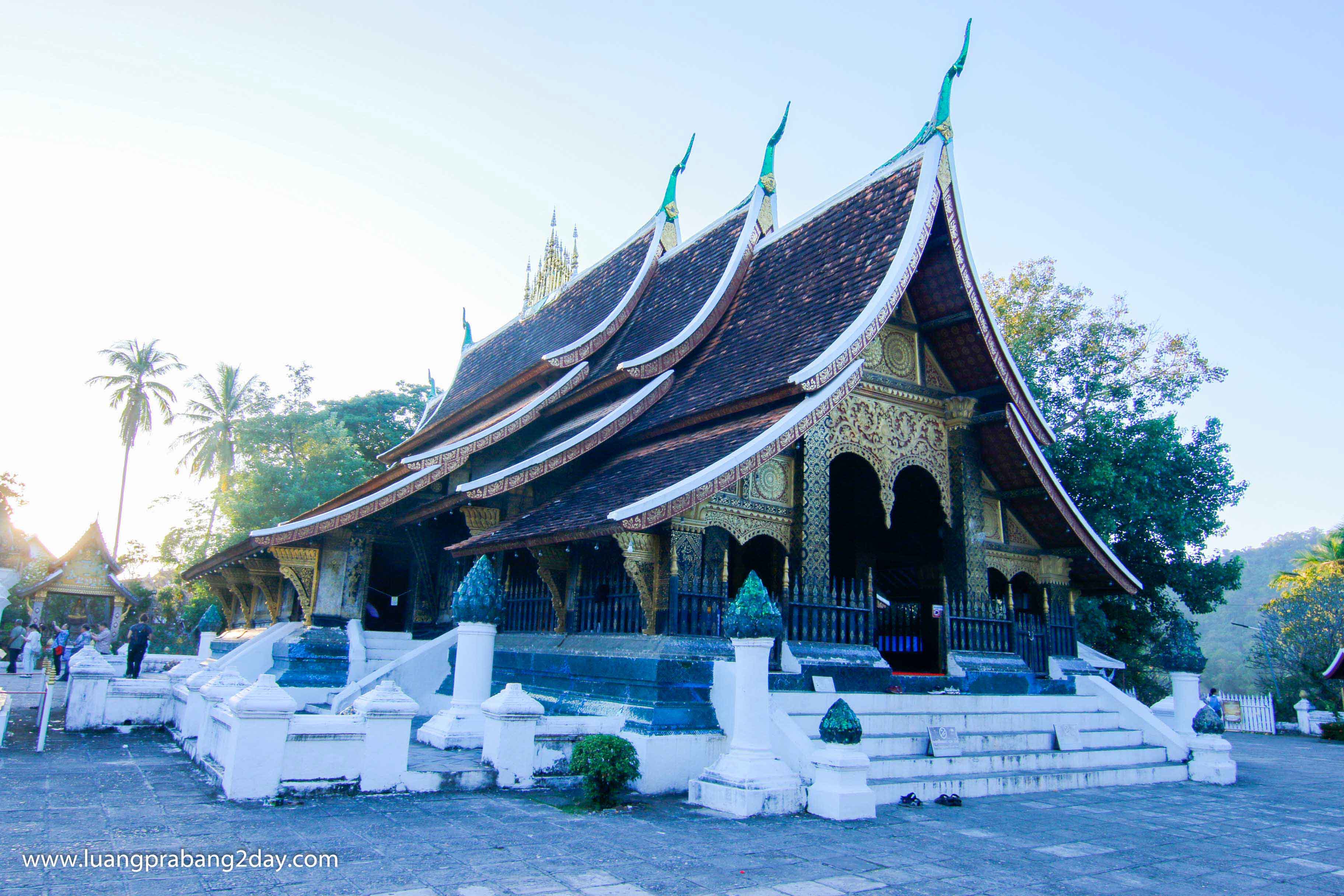
Wat Xieng Thong: The Spiritual Heart of Luang Prabang
Where Kingship, Memory, and Sacred Geography Converge
Wat Xieng Thong is often introduced as the most beautiful temple in Luang Prabang.
Visitors admire its sweeping roofs, intricate mosaics, and quiet elegance. Photographs circulate widely, reinforcing its reputation as an architectural masterpiece and a must-visit landmark.
Yet for local people, Wat Xieng Thong represents something far deeper than beauty.
It is not simply a temple among many.
It is the spiritual heart of the old royal city — a place where belief, authority, memory, and geography converge into a living expression of Lao civilization.
To understand Luang Prabang fully, one must look beyond the temple’s visual harmony and recognize the invisible meanings embedded within it.
Wat Xieng Thong is not merely seen.
It is understood.
Sacred Geography: Where Rivers Meet Meaning
Wat Xieng Thong stands at the northern tip of the Luang Prabang peninsula, precisely where the Mekong and Nam Khan rivers quietly meet.
This location was not chosen for scenery.
In traditional Lao cosmology, geography carries spiritual significance. Water is not only a natural resource but a living force associated with protection, renewal, and continuity.
The meeting of rivers represents convergence — a place where energies align and balance is maintained.
Such locations were understood as spiritually potent. They formed natural thresholds between worlds: sacred and worldly, stability and movement, permanence and change.
Placing a royal temple at this point established more than a religious site. It created a symbolic guardian of the city.
The temple marked the edge of royal space — a spiritual boundary protecting the capital while anchoring it within cosmic order.
In this sense, Wat Xieng Thong functioned as both sanctuary and safeguard.
The city did not grow around the temple by accident.
The temple defined how the city understood itself.
Kingship and Sacred Authority
Wat Xieng Thong was constructed in the late sixteenth century during the reign of King Setthathirath, one of the most significant rulers of the Lan Xang Kingdom.
Its creation coincided with a period when political authority and spiritual legitimacy were inseparable.
In Lao tradition, kingship required moral alignment as much as political power. A ruler’s authority depended on merit — accumulated through religious devotion, patronage of monasteries, and support for the Sangha.
Wat Xieng Thong became the temple most closely associated with this sacred dimension of kingship.
Coronations passed through its grounds.
Royal rituals unfolded within its walls.
State ceremonies reaffirmed legitimacy before both people and cosmos.
The temple did not merely host royal events.
It validated them.
To understand Lao monarchy, therefore, is not simply to study governance structures but to recognize how spiritual authority grounded political life.
Power without merit could not endure.
Wat Xieng Thong embodied this principle architecturally and ritually.
The Persistence of Spiritual Capital
When the royal capital later shifted to Vientiane, political authority moved geographically.
Spiritual authority did not.
Luang Prabang retained its sacred status, and Wat Xieng Thong continued to function as a repository of legitimacy.
The temple quietly preserved memory across generations.
Kings disappeared. Governments changed. Historical eras passed.
Yet rituals continued.
Monks maintained cycles of learning and practice. Artisans preserved techniques inherited from earlier centuries. Communities returned repeatedly, reinforcing continuity through participation rather than proclamation.
The temple became a living archive — not of documents, but of practice.
Here, legitimacy was remembered rather than enforced.
Architecture as Philosophy
The architecture of Wat Xieng Thong communicates meaning beyond aesthetics.
Its low, sweeping roofs are among the most recognizable features of Lao temple design. Yet they are not expressions of grandeur.
They express humility.
The descending rooflines draw the eye downward, encouraging visitors to lower themselves physically and mentally when entering sacred space.
Architecture guides behavior.
Multiple roof tiers signal importance and sacred hierarchy, but the overall form avoids dominance. Unlike monumental structures designed to impress through scale, Wat Xieng Thong invites quiet reverence.
This reflects a distinctly Lao aesthetic shaped by Buddhist philosophy.
Sacredness is communicated through balance rather than spectacle.
Harmony replaces monumentality.
The building teaches without words.
The Tree of Life: A Visual Teaching
At the rear of the sim stands the celebrated “Tree of Life” mosaic.
To outside observers, it appears as decorative artistry — a luminous composition of colored glass depicting branching forms against a dark background.
For local communities, it functions differently.
The image represents continuity.
Roots connect unseen origins to visible life. Branches extend outward while remaining unified. Animals and natural elements coexist within a shared system.
The mosaic communicates Buddhist and animist understandings simultaneously: rebirth, interconnected existence, and the inseparability of humans, nature, and the spiritual realm.
It is not merely art.
It is instruction rendered visually.
Visitors photograph it.
Residents contemplate it.
Survival Through Respect
Wat Xieng Thong survived wars, colonial periods, political transitions, and social transformation.
Its survival cannot be explained solely through protection.
During the sacking of Luang Prabang in the nineteenth century, when destruction affected much of the region, the temple was spared.
This historical moment reveals something essential.
Sacred learning commanded respect even amid conflict.
The temple’s value was recognized beyond political allegiance.
Preservation emerged not from immunity but from shared acknowledgment of spiritual importance.
Respect protected what force did not destroy.
Memory and Lived Experience
Today, visitors walk through Wat Xieng Thong with cameras.
They seek beauty, atmosphere, and historical curiosity.
Local people move differently.
They walk through memory.
For many residents, the temple marks personal milestones — ceremonies, teachings, moments of reflection passed across generations.
It functions not as a monument frozen in history but as an active participant in daily life.
Children learn cultural rhythm here. Monks maintain continuity through practice. Elders revisit familiar spaces shaped by decades of lived experience.
The temple remains alive because participation continues.
Sacred Space in a Changing World
Modern visibility introduces new pressures.
Global tourism transforms perception. Digital media accelerates circulation of images. Expectations reshape how sacred spaces are encountered.
Wat Xieng Thong now exists simultaneously in two worlds:
as a global symbol admired internationally,
and as a local spiritual anchor sustaining continuity.
Balancing these roles requires cultural diplomacy — an understanding that visibility must coexist with respect.
The temple does not resist being seen.
But it asks to be understood before being consumed.
Beyond the “Must-Visit” Narrative
Describing Wat Xieng Thong as a “must-visit attraction” simplifies its meaning.
Such language transforms sacred presence into itinerary.
The temple’s significance lies not in visitation but in relationship.
It represents:
faith practiced across centuries,
craftsmanship refined through devotion,
and the enduring belief that authority without spirituality cannot last.
Beauty attracts attention.
Meaning sustains continuity.
The Soul of Luang Prabang
Wat Xieng Thong has long functioned as a spiritual compass for the city.
Its presence reminds Luang Prabang of its origins and responsibilities.
While political centers may shift, sacred centers anchor identity.
The temple embodies an understanding central to Lao culture:
power must remain aligned with humility,
change must respect continuity,
and community must remain connected to spiritual grounding.
Seen through this perspective, Wat Xieng Thong is not simply part of Luang Prabang.
It is the place through which Luang Prabang recognizes itself.
Closing Reflection
To stand within Wat Xieng Thong is to encounter more than architecture.
It is to enter a conversation between past and present.
The temple teaches quietly:
that legitimacy grows from respect,
that beauty emerges from balance,
and that endurance belongs to what remains spiritually grounded.
Visitors may remember its elegance.
Local people remember its meaning.
To see Wat Xieng Thong only as a landmark is to miss its essence.
It is, and has always been, the living soul of Luang Prabang — a witness to faith, craftsmanship, and the enduring relationship between spirituality and civic life.
LuangPrabang2Day
Authority before action.
Understanding before decision.
ABOUT THE AUTHOR
Hello We are OddThemes, Our name came from the fact that we are UNIQUE. We specialize in designing premium looking fully customizable highly responsive blogger templates. We at OddThemes do carry a philosophy that: Nothing Is Impossible