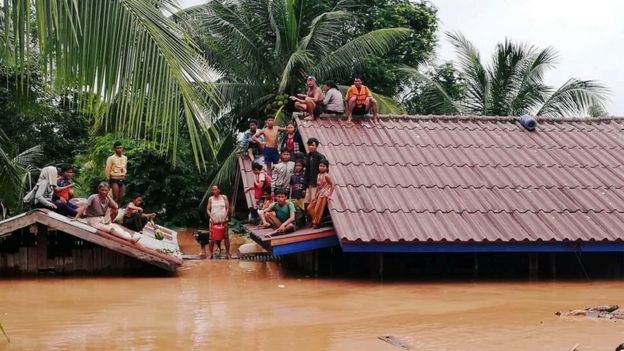
At least 20 people have been killed and more than 100 are missing in flooding following the collapse of an under-construction dam in south-east Laos.
Workers found the hydroelectric dam in Attapeu province was partially damaged on Sunday, and villagers living nearby were evacuated.
The dam collapsed late on Monday, sending flash floods through six villages.
More than 6,600 people have been made homeless, Lao News Agency reported.
Pictures showed villagers and young children stranded on the roofs of submerged houses.
Attapeu is Laos' southernmost province, and borders Cambodia and Vietnam.
It is known for agriculture, rich trees and wood-based industries - and hydropower is one of its major exports.
What do we know about the dam - and how did it collapse?
The dam that collapsed is part of the Xe-Pian Xe-Namnoy hydroelectric power project, which involves Laotian, Thai and South Korean firms.
The subsidiary dam, known as "Saddle Dam D", was part of a network of two main dams and five subsidiary dams.
SK Engineering & Construction, a South Korean company with a stake in the project, said fractures were first discovered on the dam on Sunday, before it collapsed:
- Sunday 21:00 local time (14:00 GMT) - The dam is found to be partially damaged. The authorities are alerted and villagers near the dam start to be evacuated. A team is sent to repair the dam - but is hampered by heavy rain, which has also damaged many roads.
- Monday 03:00 - Water is discharged from one of the main dams (Xe-Namnoy dam) to try to lower water levels in the subsidiary dam.
- Monday 12:00 - The state government orders villagers downstream to evacuate after learning that there could be further damage to the dam.
- Monday 18:00 - More damage is confirmed at the dam.
- By Tuesday 01:30, a village near the subsidiary dam is flooded, and by 09:30 seven villages are flooded.
Ratchaburi Electricity Generating Holding, the main Thai stakeholder, said in a statement that the dam "was fractured" after "continuous rainstorm[s]" caused a "high volume of water to flow into the project's reservoir".
As a result, water "leaked to the downstream area and down to Xe-Pian River" about 5km (three miles) away, it added.
"Saddle Dam D" was 8m wide, 770m long and 16m high - and was designed to help divert water around a local reservoir, the company said.
Both Ratchaburi Electricity Generating Holding and SK Engineering & Construction say they have been helping with evacuation and relief operations.
What is being done to help those affected?
Officials have been trying to rescue stranded villagers by boat.
Local authorities have appealed to government bodies and other communities to provide emergency aid such as clothing, food, drinking water and medicine.
Meanwhile, Prime Minister Thongloun Sisoulith has postponed government meetings and gone to the affected area in Sanamxay district to monitor relief efforts, state media says.
One local Attapeu official told AFP news agency that there was no phone signal in the flooded areas, adding to communication problems.
Hydroelectric ambitions in Laos
- The government in Laos has launched an ambitious dam-building scheme to become the "battery of Asia"
- Laos sits on the Mekong River and its tributaries - a perfect location for hydroelectric power
- The country had 46 operational hydroelectric power plants in 2017, and 54 more under construction
- By 2020, Laos also plans to build 54 more electricity transmission lines and 16 substations
- Laos already exports two-thirds of its hydropower, with electricity making up roughly 30% of all Laotian exports
Sources: Hydropower.org, the Laotian Times and Lao News Agency
credit: https://www.bbc.com/news/world-asia-44935495